HW2 By Lazlo Ring
1.
Stress Relief Station.
The Stress Relief Station is a kiosk based system
designed to relax patients in hospital waiting rooms. The Kiosk is set up
with an interactive Agent that greets the user when they are in close proximity
to the station (detected via a weight activated switch in front of the
kiosk). Through a touch screen interface, the patient communicates why they
are at the hospital by selecting very broad topics (I.E. I’m here for a
checkup, I’m here for a test, I’m here with someone else, etc). Based on
what was selected, the Agent will then give the patient positive facts
about the Hospital, and try to relieve some of their worries by having them
“talk” out their concerns. 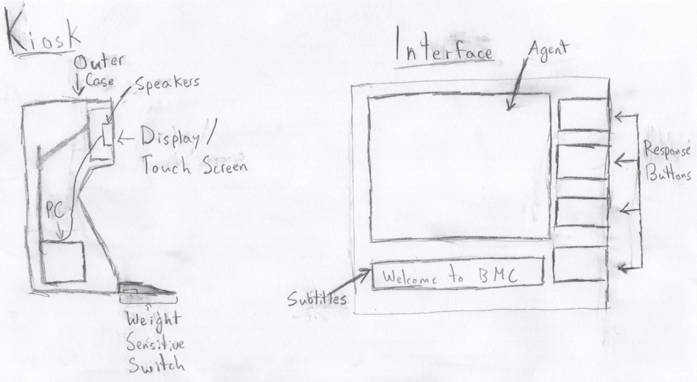
2. Health risk
Assessment System.
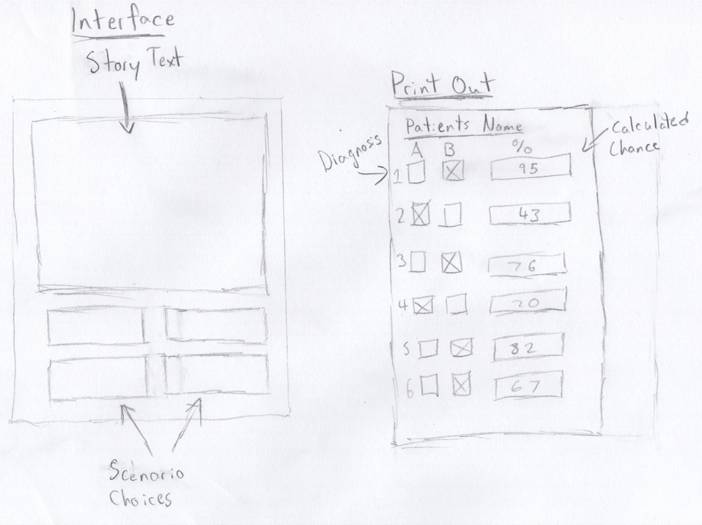
The Health Risk Assessment System is a kiosk based
system that tries to identify mental and physical health problems prior to
the patient seeing their doctor. When the patient approaches the system,
they are presented with a series of stories, which ask the patient what
they would do in certain scenarios. All of the stories are based off of
standard diagnosis tools, and are used to try and identify mental and
physical health problems that are more prevalent in older populations, such
as early signs of Alzheimer’s or Dementia. Once the patient has finished
interacting with the system, a piece of paper is printed out so that the
doctor can quickly see if he should do further screenings for any of these
problems.
3. Computerized
Information Station
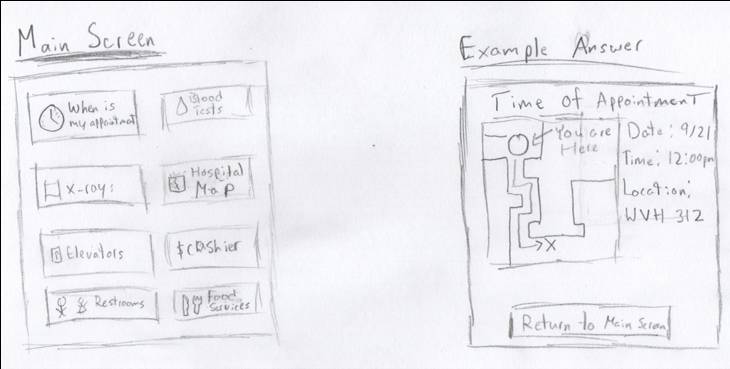
The Computerized Information Station is a kiosk system
designed to answer commonly asked questions patients may have upon entering
a hospital waiting room. Upon approaching the display, patients are
presented with multiple buttons that try and answer a large range of
questions, such as when/where is their appointments, or how to I get to
another part of the hospital. Both auditory and visual responses are given
back to the patient, with the option to further elaborate on the answer.