Beyond Peak Oil
A Survey Based On Primary Statistics
The main web page for this site is
Beyond Peak Oil.
The web pages continue to slowly evolve. A PDF document based on the
web site as of May, 2004 is also available.
-
peakoil-04.pdf (pdf version of web pages, 625 KB,
21 pages, many graphs, May, 2004)
-
peakoil-04-part1.pdf (3 pages, 165 KB, many graphs)
(Part 1 only; brief introduction to the issues)
There are many excellent sites describing the issues of peak oil
and oil depletion. The emphasis of this exposition is that
- I summarize the main
data and arguments through easy-to-read graphs, with a minimum of
text; and
- the documents link the data to the original sources on
the Web.
It is surprising how much high
quality, authoritative information can be obtained from a careful
search of the Web.
To summarize,
some expert
petroleum geologists have put together the
most detailed predictions of future oil production, to date. They
have concluded that we will reach peak oil production sometime in the
years 2007-2012. While there will not be a rapid drop in oil
production thereafter, there also will not be any capacity for
additional oil production to fuel the world's growing economies.
Until a transition to alternative energy sources is accomplished, this
situation will throw a long shadow over today's economies.
- Gene Cooperman
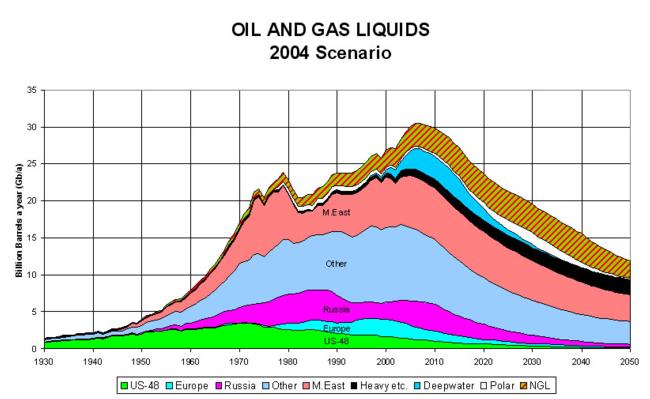
Figure 12:
World Oil Production (predictions of 2004 Hubbert Model,
from ASPO Newsletter below)
|
|
Overviews of Oil Depletion by Some of the Experts
Note that the definition of oil is not fixed. E.g., does it include
Ethanol? Crude oil plus condensates (C+C) is often a common
choice, with condensates largely from natural gas wells.
(see
natural gas liquids
Selection of Other Web Sites with Information on Oil Depletion
-
Selected Features of Giant Fields, Using Maps and Histograms, M.,K. Horn, 2004 (detailed description of oil fields and depletion as of 2004; cited by JODI Iraqi Reserves and Ghawar)
-
How To Boil A Frog (humorous exposition)
- ASPO Newsletters (from
Peakoil.net);
ASPO is an organization of petroleum geologists who are
publicizing the pertinent information. Their newsletter includes
the most detailed model of current and projected oil production
there is, including country-by-country studies.
-
oildepletion.org (compilation of information by Roger Bentley
based on discussions with petroleum geologists and others)
-
Energy Watch Group - Oil Report (see Executive Summary,
October 2007, for excellent up-to-date summary of issues)
-
Willkommen in der Energiekrise (mostly in German,
but some of the most readable and detailed expositions on the Web are
available here)
- Oil Depletion Analysis Centre
(a British organization, with links to an excellent collection
of articles; see, for example
analysis
of Saudi oil)
- The Coming Global Oil Crisis
(another British group dedicated to publicizing the issues, and with
links to many experts)
- EnergyBulletin.net
(comprehensive collection of energy news in the press, well organized
by category)
- ASPO-USA Weekly Peak Oil Review
- Peak Oil News
(in blog format);
and
Peak Oil News and Message Boards; and
Oilcast (regular audio)
- Green Car Congress
(technologies related to fuel-efficient, sustainable cars ---
the single largest consumer of oil)
- Global Public Media
(American group with interviews on oil depletion and on
environmental issues, video and transcripts)
Sources of Statistics on Oil
Regularly Appearing Statistics
-
BP Statistical Review of World Energy 2015
(with
oil statistics)
-
ExxonMobil 2015 Outlook for Energy
(or summary page)
- oilmarketreport.org (from IEA)
- Joint Oil Data Initiative Global Data
(aggregations of statistics from producing countries)
-
International Energy Agency (IEA) Publications
(see especially
World Energy Outlook, annual series,
Key World Energy Statistics, and other
free publications -- free after 2 to 3 years);
2014 World Energy Outlook;
-
EIA International Energy Annual
(from
Energy Information Administration of U.S. government);
Energy Information Administration (EIA) Annual Energy Review
(see especially
Energy Resources and
Petroleum);
EIA individual country reports; and
Annual Energy
Outlook (projections to 2040 for U.S.; with
forecast evaluation and
past editions);
International Energy Outlook
-
Basic Petroleum Statistics (EIA, U.S. government)
-
North Dakota Oil Production Statistics (Baaken formation and others, by county)
- Texas Railroad Commission (Oil and Gas Statistics)
- Offshore Production Information (BSEE)
(rising production in 1990s, steady in 2000s, declining in 2010s:
decline due to declining natural gas liquids,
as onshore fracking replaces it)
- Office of Fossil Energy of DOE
(with
International country overviews)
-
Country Analysis Briefs (EIA/DOE)
(including
Iraq, second largest reserves in world)
-
Monthly Oil Production (International Petroleum Monthly, EIA)
Estimates of recoverable oil
- Predicted production and estimates of recoverable oil by country
(based on Hubbert Peak methodology)
-
Resources for (Estimated Ultimately Recoverable) Oil and
Natural Gas, based on USGS 2000 assessment using 1996 data
(with
details for each country)
- Predicted World Oil Production Capacity (excluding Liquids such
as ethanol) by Country
(EIA, International Energy Outllook, Appendix)
- Take a projection (e.g. Saudi Arabia, for 20 years in future,
and compare predictions in 1996 versus latest prediction)
- Outlook (most recent: 2013) (Appendix Table G2: 2010 - 2040)
-
Outlook 2011: 2006 - 2035 (Projection/Appendix, Table E1)
-
Outlook 2010: 1990 - 2035 (Projection/Appendix, Table G2)
-
Outlook 2009: 1990 - 2030 (Projection/Appendix, Table G2)
-
Outlook 2008: 1990 - 2030 (Projection/Appendix, Table G2)
-
Outlook 2007: 1990 - 2030 (Projection/Appendix, Table G2)
-
Outlook 2006: 1990 - 2030 (Projection/Appendix, Table E1)
-
Outlook 2005: 1990 - 2025 (Projection/Appendix, Table E1)
-
Outlook 2004: 1990 - 2025 (Table D1)
-
Outlook 2003: 1990 - 2025
-
Outlook 2002: 1990 - 2020
-
Outlook 2001: 1990 - 2020
-
Outlook 2000: 1990 - 2020
-
Outlook 1999: 1990 - 2020 (Table D1)
-
Outlook 1998: 1990 - 2020 (Table A40)
-
Outlook 1997: 1990 - 2015 (Appendix, Table A40)
-
Outlook 1996, 1990 - 2015 (Appendix, Table A34)
-
Current crude oil production by country
(or
another version)
(Note crude oil does not include natural gas liquids, etc.)