problems from Astrachan:
12:13 Write a function Reverse( ) that reverses the order of the nodes in a linked list. Reverse the list by changing pointers, not by swapping info fields.
void Reverse(Node * & list)
// precondition:        list = (a b c . . . d)
// postcondition:        list = (d . . . c b a), list reversed
Here are two solutions. The first is iterative, the second recursive, but not pretty. A better solution would return Node* instead of void.
void Reverse(Node* &list){
	if (list)		// if list has 0 or 1 element, don't do anything
		if ((list->next)){
			// list has more than one element
			Node* p = list->next;
			list->next = NULL;	// this will end the list
			Node* q;
			while ((p->next)){
				q = p->next;
				p->next = list;
				list = p;
				p = q;
			}
			p->next = list;
			list = p;
		}
}


void RecReverse(Node* &list, Node* &tail){
	if (!list) tail = NULL;	// empty list
	else
	if (!(list->next)){	// list has one element
		tail = list;
	}
	else{
		cout << "list->  " << list->data << endl;
		Node* Rlist = list->next;
		RecReverse(Rlist, tail);	// reverse the rest of the list
		list->next = NULL;	// prepare first node to be end of list
		tail->next = list;	// put first node at end of reversed list
		tail = list;	// set tail to end of list
		list = Rlist;
	}
}
12:14 Write a function that doubles a linked list by duplicating each node, i.e. the list (a b c d) is changed into (a a b b c c d d). Use the header below where list is NOT passed by reference.
void DoubleList(Node * list)
// precondition:  if   list = (a b c d)
// postcondition: then list = (a a b b c c d d)

Node* DoubleList(Node* list){
	Node* ptr = list;
	Node* extra = NULL;
	while (ptr){
		extra = new Node;	// create space for the new node
		extra->data = ptr->data;	// copy the data from original node
		// insert extra node after original node
		extra->next = ptr->next;
		ptr->next = extra;
		// advance ptr to next original node
		ptr = extra->next;
	}
}
Problem 3
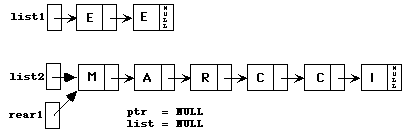
Original list for all three parts of the problem:

3a) The main loop in the code is:
	while (rear1 != NULL) {
	if (rear2 != NULL) {
		rear1->next = rear2->next;
							//rear1->next now points to node after rear2->
		rear1 = rear2->next;
							//rear1 now points to node after rear2->
	}
	else {
		rear1->next = NULL;	// the list is terminated by NULL
		rear1 = NULL;	// rear1 no longer points to the list
	}
	// the rest is as above with rear1 and rear2 reversed
	if (rear1 != NULL) {
		rear2->next = rear1->next;
		rear2 = rear1->next;
	}
	else {
		rear2->next = NULL;
		rear2 = NULL;
	}
}// rear1 and rear2 leap frog over each other, picking up alternate nodes
 // of the original list.
rear1 = rear2 = NULL 
3b)
while (rear1 != NULL) {
	if (rear1->data == 'E')
		break;
	else
		rear1 = rear1->next;
}
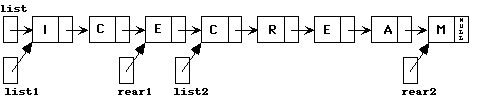
3c) Notice that in parts a) and b), the pointer list never changes. In this part, moves along the list until it becomes NULL. list1 collects all the nodes with character 'E' while list2 collects all the other nodes. rear1 never was used after it was set to list.
Last Updated: April 6, 1997 11:48 pm by