Just-in-Time Information for Exercise Adoption
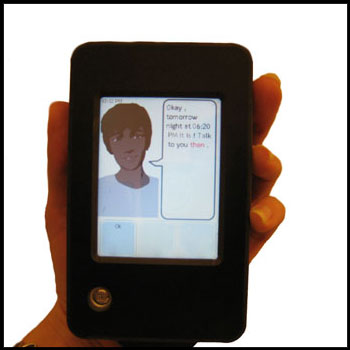
What happens if you put an exercise coach on a wearable computer? What if the coach could actually sense whether you were doing your exercise or not? And, what if the coach were designed to get to know you, your personal likes and dislikes, and something about your life plans?
This project explores these questions through the development and evaluation of an innovative automated portable exercise advisor system. The system incorporates a PDA, a motion sensor (accelerometer), and a relational agent, and is designed to interact with people over extended periods of time to set and follow up on daily exercise goals.
Once developed, the system will be used in a year-long field study in which volunteers will use it for eight weeks at a time to test how well different aspects of the system works. There are two primary research questions we are investigating in the study:
-
Is it more effective to provide motivational messages at the point in time when people are deciding whether or not to exercise, compared to the same messages delivered in a review session at the end of the day (retrospectively, as is currently done in most behavior change interventions)?
-
Is it more effective for motivational messages to be delivered by a relational agent (a personal, social, animated conversational coach), compared to the same messages delivered by a non-relational, text-only interface?
This research is being supported by a grant from the NIH National Library of Medicine (1R21LM008553), and is a collaborative effort between Timothy Bickmore at Northeastern University, MIT and Harvard Medical School.
Publications:
-
Bickmore, T., Mauer, D., and Brown, T. (2009) Context Awareness in a Handheld Exercise Agent. Pervasive and Mobile Computing special issue on Pervasive Health and Wellness, Vol 5, 226-235. PDF
- Bickmore, T., Mauer, D., Crespo, F., and Brown, T. (2007) Negotiating Task Interruptions with Virtual Agents for Health Behavior Change. Autonomous Agents and Multi-Agent Systems (AAMAS) '08 PDF
- Bickmore, T., Mauer, D., and Brown, T. (2007) Context Awareness in Mobile Relational Agents. Intelligent Virtual Agents '07, Paris.PDF
- Bickmore, T., Mauer, D., Crespo, F., and Brown, T. (2007) Persuasion, Task Interruption and Health Regimen Adherence. Persuasive Technology '07, Stanford, CA. PDF
- Bickmore, T. (2007) What Would Jiminy Cricket Do? Lessons From the First Social Wearable. HCI International '07, Beijing, China. PDF
- Bickmore, T., Gruber, A., Intille, S., and Mauer, D. (2006) A Handheld Animated Advisor for Physical Activity Promotion. American Medical Informatics Association Annual Symposium, Washington, DC.
- Bickmore, T. and Mauer, D. (2006) Modalities for Building Relationships with Handheld Computer Agents. Proceedings of the ACM SIGCHI Conference on Human Factors in Computing Systems (CHI), Montreal, Canada. PDF
- Bickmore, T. (2006) Wearable Relational Agents for Health. Ann Behav Med 31 (Suppl) : S185